Research Analysis: The Fundamental Templates of Quality Ads
Advertising
Artificial intelligence is fundamentally changing marketing. In this new world order, marketing is either
- Positioning yourself for inclusion in the training of large language models (LLMs) so that they cite you as a source, driving the end user to your properties when they review the links provided by the model. (This LLM fodder content is where all the technical depth and detail about your solutions needs to be conveyed)
- or making things geared toward the emotional to capture the hearts and minds of humans directly and remind them that we’re still capable of experiencing emotions organically.
Today, as marketers, when we’re making advertisements intended for direct consumption by humans, it’s not about communicating technical capabilities (that research will be done with LLMs). It’s about making an emotional connection.
This blog reviews research on a templated approach to creating advertisements. When we approach projects requiring that human connection, what’s old is new again. Although this research is almost three decades old, it still rings true.
The research and why it is unique
This post is analysis of the research, The Fundamental Templates of Quality Ads.
Goldenberg, Jacob, David Mazursky, and Sorin Solomon. “The Fundamental Templates of Quality Ads.” Marketing Science 18, no. 3 (1999): 333–51.
This research is unique is that it takes a process stereotypically considered artistic and highly subjective and moves into the realm of science.
Background and analysis
In 1999, a research team assembled a group of 200 highly regarded ads—ads that were finalists and award winners in the top advertising competitions. They found that 89% of the award-winning ads could be classified into six basic categories or templates.
The ad templates in the study are broken out in the taxonomy in the figure below. Beneath the image is some commentary and examples for a few of these templates.
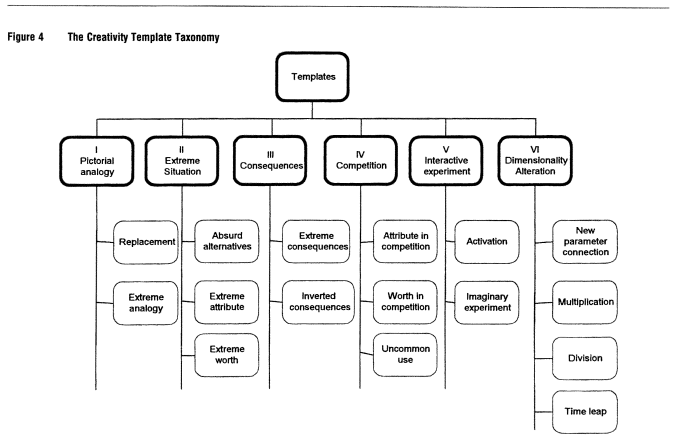
- Pictoral Analogy
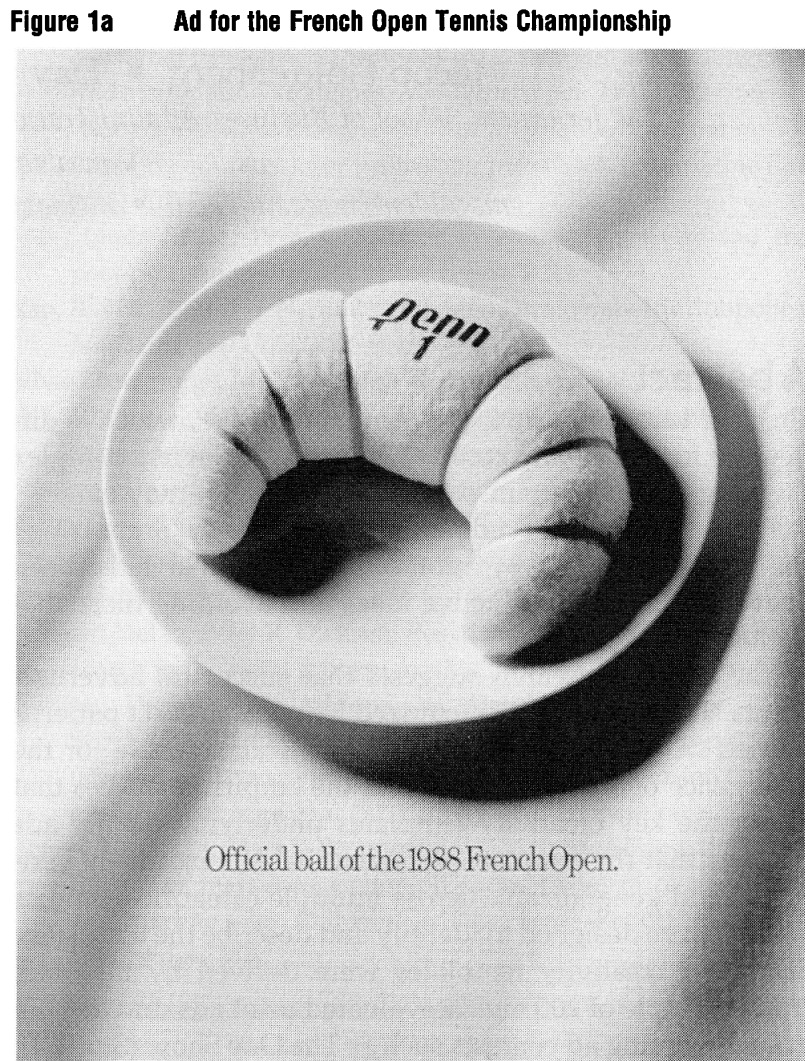
- Replacement: A 1988 French Open ad shows a Penn 1 tennis ball in the shape of a croissant. The product (Tennis Ball) is replaced with something that resonates with the target market (A Croissant)
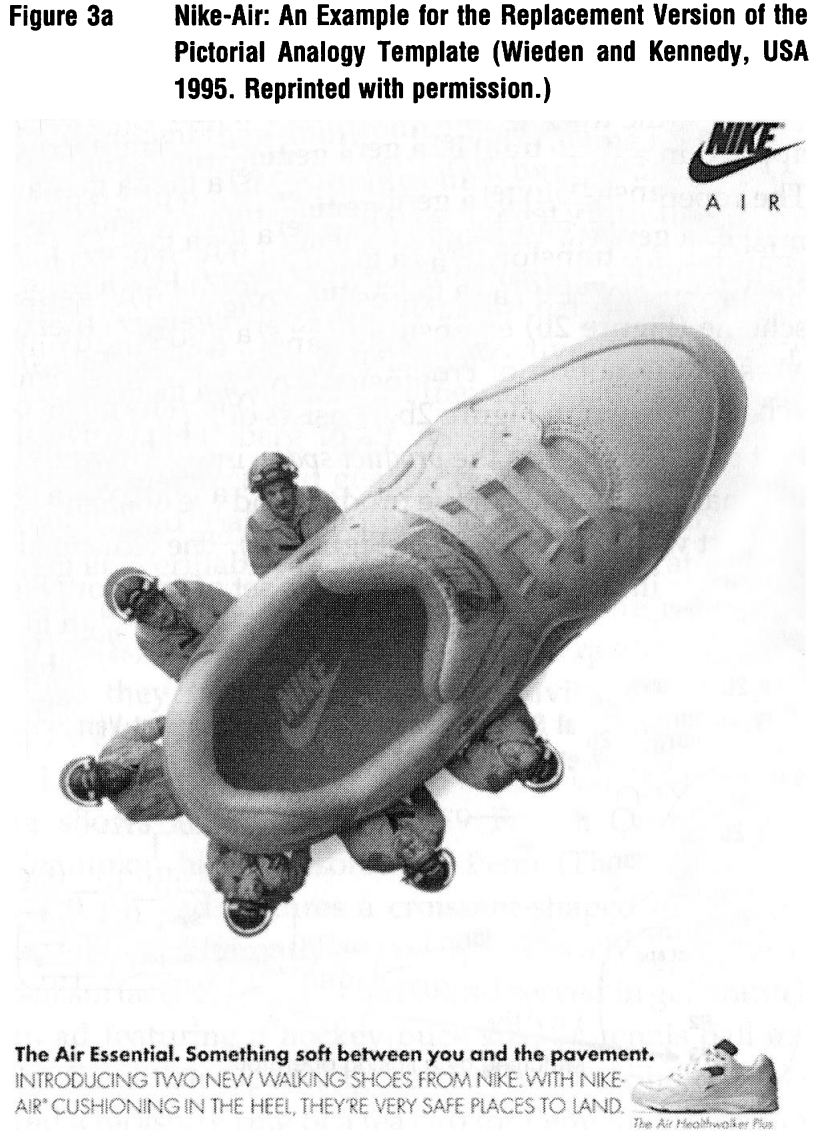
- Extreme analogy: A Nike ad is shot from the perspective of someone jumping from a tall building. A group of firemen are on the street below, preparing to cushion the jumper’s fall with an oversized Nike sneaker. The tagline reads, “Something soft between you and the pavement.”
- Replacement: A 1988 French Open ad shows a Penn 1 tennis ball in the shape of a croissant. The product (Tennis Ball) is replaced with something that resonates with the target market (A Croissant)
- Extreme Situations: A product is shown performing under unusual circumstances or in which a product’s attribute is exaggerated to the extreme
- Absurd Alternative: The commercial for locks showing an old lady scaring away burglars by barking at them (Suissa Miller Advertising Company, USA, 1993, Cannes contest award) conveys the message that a safe and peaceful evening can be achieved either by buying a certain lock or barking. Watch
- Consequences: Extreme consequences examples
- A commercial for Pioneer car speakers shows a bridge on the verge of collapse when the loudspeakers of the car parked on it are turned on at high volume. The message is that the music can be played so loud that even the sturdy foundations of the bridge are threatened by its impact (BBD, Los Angeles, 1994, Cleo award winner) Watch
- Loose lips sink ships Read
- Eggs sizzling “This is your brains on drugs” Read
- Newton discovering gravity when the apple landed on his head
- Competition: A product is shown winning in a competition with another product, often in an unusual usage situation
- Uncommon use: A commercial for jeans showing a couple in a broken-down car being towed by a pair of jeans tied to the rescuing car Watch
- Interactive Experiments: Where viewers interact with the product directly
- Activation: A print ad containing a large black patch. When the viewer performs the action suggested in the ad, he/she would become aware of the necessity of an anti-dandruff shampoo (DDB, Needham San-Paulo, 1995) See a recreation
- Dimensionality Alteration:
- Time leap: An ad that shows the long-run implications of a decision. A commercial for life insurance showing a wife arguing with her husband for canceling his life insurance. The whole scene takes place after he dies, and portrays the wife communicating with her late husband in the setting of a seance (A Cannes award winner in 1993)
The majority of the competition winners were composed using Pictorial Analogy and Extreme Consequences templates.
Of note for the software industry: It’s my hypothesis that some of these templates are best applied for physical products, and won’t work well for software products. For example, “Interactive Experiments” and “Pictoral Analogy,” will only be adopted successfully for software advertisement in extreme circumstances.
Bringing science to the art
For this research, the team brought in three groups of novices and gave each group some background information about three products: a shampoo, a diet-food item, and a sneaker. One group received the background information on the products and immediately started generating ads, with no training. An experienced creative director, who didn’t know how the group had been trained, selected its top fifteen ads. Then those ads were tested by consumers. The group’s ads stood out: Consumers rated them as “annoying.”
A second group was trained for two hours by an experienced creativity instructor who showed the participants how to use a free-association brainstorming method. Again, the fifteen best ads were selected by the same creative director, who didn’t know how the group had been trained, and the ads were then tested by consumers. This group’s ads were rated as less annoying than those of the untrained group but no more creative.
The final group was trained for two hours on how to use the six creative templates. Once again, the fifteen best ads were selected by the creative director and tested with consumers. Their ads were rated as 50 percent more creative and produced a 55 percent more positive attitude toward the products advertised. This shows there are systematic ways to produce creative ideas.
What to read next
This research, “The Fundamental Templates of Quality Ads” was cited in Made to Stick: Why Some Ideas Survive and Others Die by Chip and Dan Heath.